Section 2.1 Problem Set Success Guide
What are Problem Sets?
The term Problem Set is used commonly in STEM courses at Brown and, generally, means some form of written assignment in which students solve problems. While this term may be familiar, the experience of working on a problem set varies greatly between courses because different courses may have different expectations for quality and style of writing, and there may be different expectations surrounding the types of problems that students are expected to solve.
The purpose of this brief guide is to clarify expectations around Problem Sets in this course. Your Problem Sets make up a significant portion of your grade and, as such, are expected to take a significant amount of time and effort to do well on them.
What Kinds of Problems Will Appear on Problem Sets?
Different types of problems assess different learning outcomes and promote the development of different skills and habits.
Broadly speaking, the problems that you encounter in this course (both inside and outside of the classroom) fall into the following types:
-
Scaffolded Exploration problems introduce you to a new concept through a sequence of carefully scaffolded activities. These activities include exploratory activities to motivate an entire line of thinking; working a series of examples to have students realize the need for a new definition; and working a carefully scaffolded problem to develop a general algorithm for solving similar problems, for example.
-
Fluency Builders are designed to help you develop fluency in a new concept. Examples of such problems are those that we provide for you to develop core competencies.
-
Flexible Extensions are problems that require you to apply a concept in a new setting. These problems can take a variety of forms and include: checking if something satisfies a new definition; extending an idea from its “natural” setting to something more general; or, a true application to another field or topic. In these activities, the emphasis is on developing a flexible mindset when faced with new problems.
The most common types of problems that you will work on in class are Scaffolded Explorations and Fluency Builders. In contrast, your Problem Sets will largely prioritize Flexible Extensions and Scaffolded Explorations—because these are exactly the types of problems that allow you develop your ability to knowledge-transfer.
How Will You Be Evaluated?
Written solutions are more than just answers. A complete solution to a problem:
-
clearly states what the answer to the problem is;
-
explains why the claimed answer is indeed the correct answer;
-
is grounded in sound mathematical reasoning that builds on and/or refers directly to results, Facts, or Activities that we have explored in class;
-
is written for an audience of a typical classmate; that is, someone who is generally new to these ideas and has the resources and experiences provided in this Activity Book.
The problems you submit for the portfolio check-in are, ultimately, be eligible for inclusion in your Final Portfolio. Your instructor will provide you with feedback on your solution. This feedback will be broadly focused on two categories: Problem Solving and Communication.
-
Problem Solving
-
The solution uses methods covered in class, is grounded in mathematical reasoning, and solves the problem, when executed accurately.
-
All key ideas required to solve the problem are introduced in a clear and concise manner.
-
-
Communication
-
The solution is well-written, audience appropriate, and follows principles of good mathematical writing (explained more below).
-
Mathematical terms and notations are used correctly, and Theorem and Facts are cited appropriately.
-
Solutions are uploaded to gradescope properly with all relevant pages selected for each question.
-
Your problem set will be considered “Complete” if all three problems are “Complete”. You have until the due date of the Final portfolio to incorporate feedback, seek additional feedback, and ultimately revise the solution for submission in your portfolio.
Writing Mathematics Well.
Writing Mathematics well is a skill that you can and will develop over time. Like other forms of writing, it will take a lot of practice, and the incorporation of feedback from peers and those with more expertise. While it may feel like it at the beginning, we want to stress that our goal is not to have you write the exact same way that we do. Rather, we want you to be able to express yourself precisely, so that you may share your ideas and perspectives accurately with the greater community.
The writing guide depicted below (by Francis Su of Harvey Mudd College) is a great resource that covers the basic principles of good mathematical writing. A PDF is also available. Use it a checklist when writing your solutions. Almost every deduction we give for communication is a result of work that violates at least one of these principles.
The single greatest piece of advice I can give is: write for a hypothetical student who is anxious about the material. With this audience in mind, take care not ensure that all details are explained well and that you are using ideas and terminology that we have used in class. At the same, work to remove any unnecessary text that does not help with the readability.
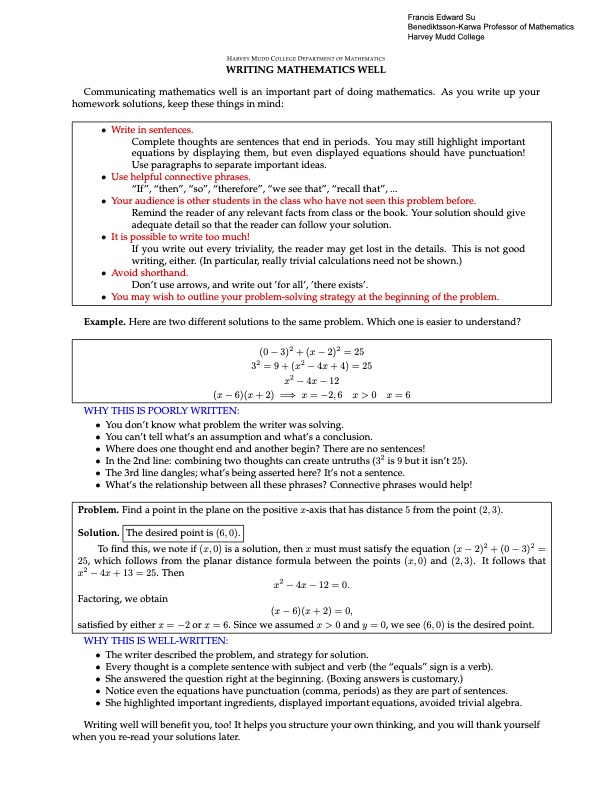
This is a short guide to writing mathematics well by Francis Su (Harvey Mudd College). A PDF is also available. Use it a checklist when writing your solutions. Almost every deduction we give for communication is a result of work that violates at least one of these principles.

